One Very Bold Idea
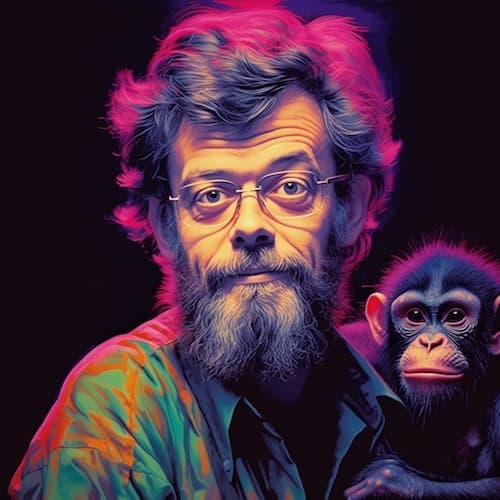
In 1992, the American ethnobotanist and mystic Terence McKenna published the book Food of the Gods. It contained an idea that people still argue about: perhaps the human mind was created, in part, by mushrooms.
In McKenna's view, our most ancient ancestors, Homo erectus, one day tasted certain mushrooms (including psilocybin-containing ones), and this gave a push to the development of language, art and imagination. This idea is jokingly called the "Stoned Ape Theory." McKenna himself didn't like the name, and his brother Dennis also considered that it oversimplifies the idea.
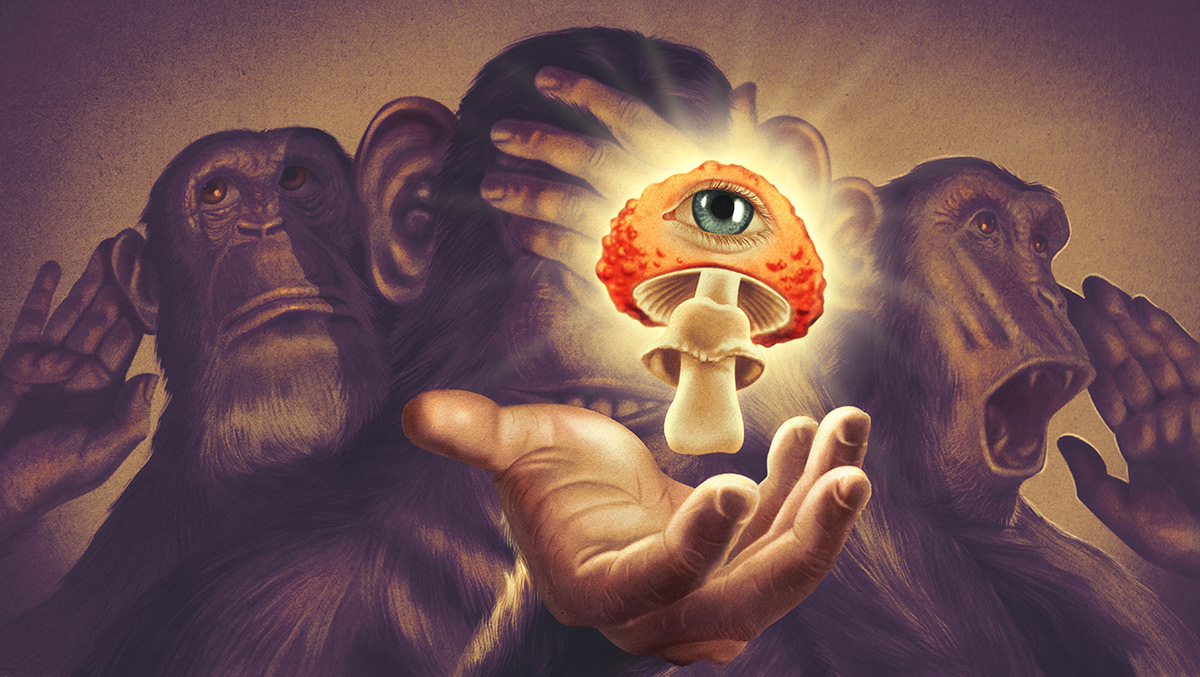
The story goes like this. In Africa the climate is changing, forests are shrinking, and our ancestors move to new places in search of food. On the way they follow herds of large cattle, because insects gather on dung, and insects are edible.
And in that very dung, according to McKenna, a psilocybin-containing mushroom, Psilocybe cubensis, often grows. Picture the scene: a hungry ancestor is looking for insects and his eye falls on one strange mushroom. From here, McKenna's imagination takes off.
And this is where the "stoned ape" story begins.
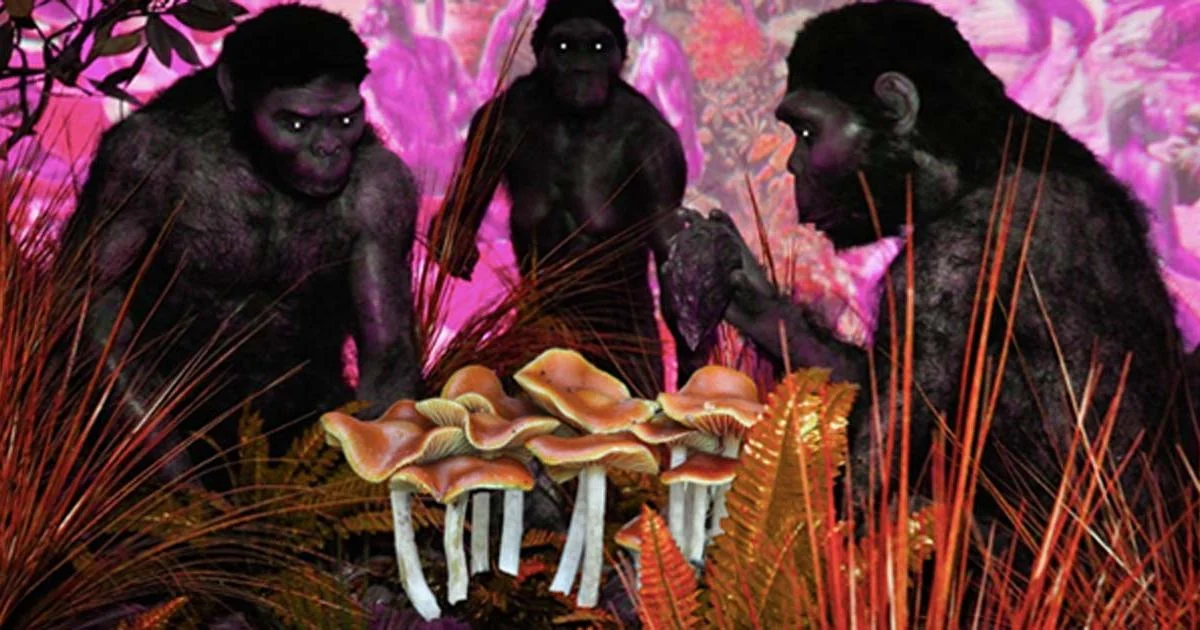
According to McKenna, the mushroom gave our ancestors three gifts
• A sharper eye. He said that in a very small amount, the mushroom improved vision, the shaping of contours and objects. That would serve a hunting ancestor well, and his descendants would multiply.
• A closer community. In a larger amount, in his view, the boundaries between people weakened: cooperation and tribal solidarity grew.
• Language, imagination and religion. McKenna said that in an even larger amount, this mushroom would cause hallucinations, and as a result the visions and sounds would turn into the raw material for the language that makes a human being human.
What the Theory's Supporters Say
Joking aside, the idea has supporters too. Among them are McKenna's brother Dennis and the mycologist Paul Stamets. Their arguments are as follows:
• A coincidence of time and place. According to Dennis McKenna, the brain grew rapidly about 2 million years ago, and at the same time Africa had ecosystems where human ancestors, large cattle and mushrooms could meet. According to new climate data, much of northern and eastern Africa was then wetter than it is today and could feed large herds.
• Brain flexibility. Psilocybin is thought to increase neuroplasticity: it "loosens" the brain's established pathways. According to the supporters, such a push could have helped ancestors toward a new kind of thinking.
• Changes without genes, too. Epigenetics shows that certain changes can be passed on without any change in genes. The supporters say that such rapid changes become easier to explain this way.
• Why is there no evidence? Dennis McKenna says we shouldn't expect a fossil of an ancestor with a mushroom clenched in his jaws: soft tissues are hardly ever preserved.
• Rock paintings. Supporters point to paintings in the Italian Alps and in Spain, at Villar del Humo, that recall mushrooms.
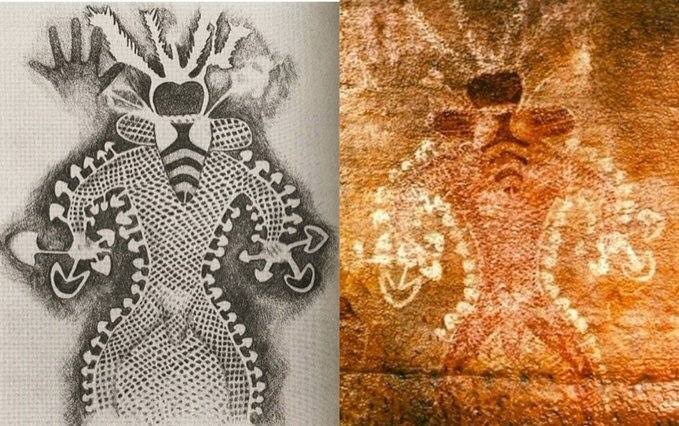
The chemistry of mysticism. According to one idea, the mushroom may have given rise to the first "mystical" experiences: the weakening of the sense of ego, a feeling of unity with the tribe and with nature, and visions of "another world." Perhaps this is exactly what, at some moment, radically changed our ancestor and lifted us, fractally, to a new level, the one that sets us apart from all the other components of nature?
In 2017, the mycologist Paul Stamets declared this idea a "very convincing hypothesis" at a conference, and the hall applauded. Most scientists, however, still say that it is a beautiful story and not a proven fact.
**Oh, and finally: this text is the history of an idea and not a recommendation. Collecting, growing or using psilocybin-containing mushrooms is prohibited in many countries, and the effect is unpredictable. **
Sources
• Stoned ape theory, Wikipedia
• What is the stoned ape hypothesis?, HowStuffWorks
• Sarah Sloat, The 'Stoned Ape' Theory Might Explain Our Extraordinary Evolution, Inverse
• Stoned Ape Theory: Could Psychedelics Have Shaped Human Evolution?, Discovery UK
• The stoned ape theory, ZME Science
• Is there evidence that magic mushrooms played a role in human evolution?, Big Think
• Mattha Busby, New Science Revives Terence McKenna's Stoned Ape Theory, DoubleBlind
• The Stoned Ape Hypothesis: Psilocybin and the Origins of Human Consciousness, McKenna Academy
• The Stoned Ape Theory Revisited, Psychology Today
This text was written in our own words, based on these sources. It is a popular-science overview, not a guide to use.