A Paradise Built for Mice
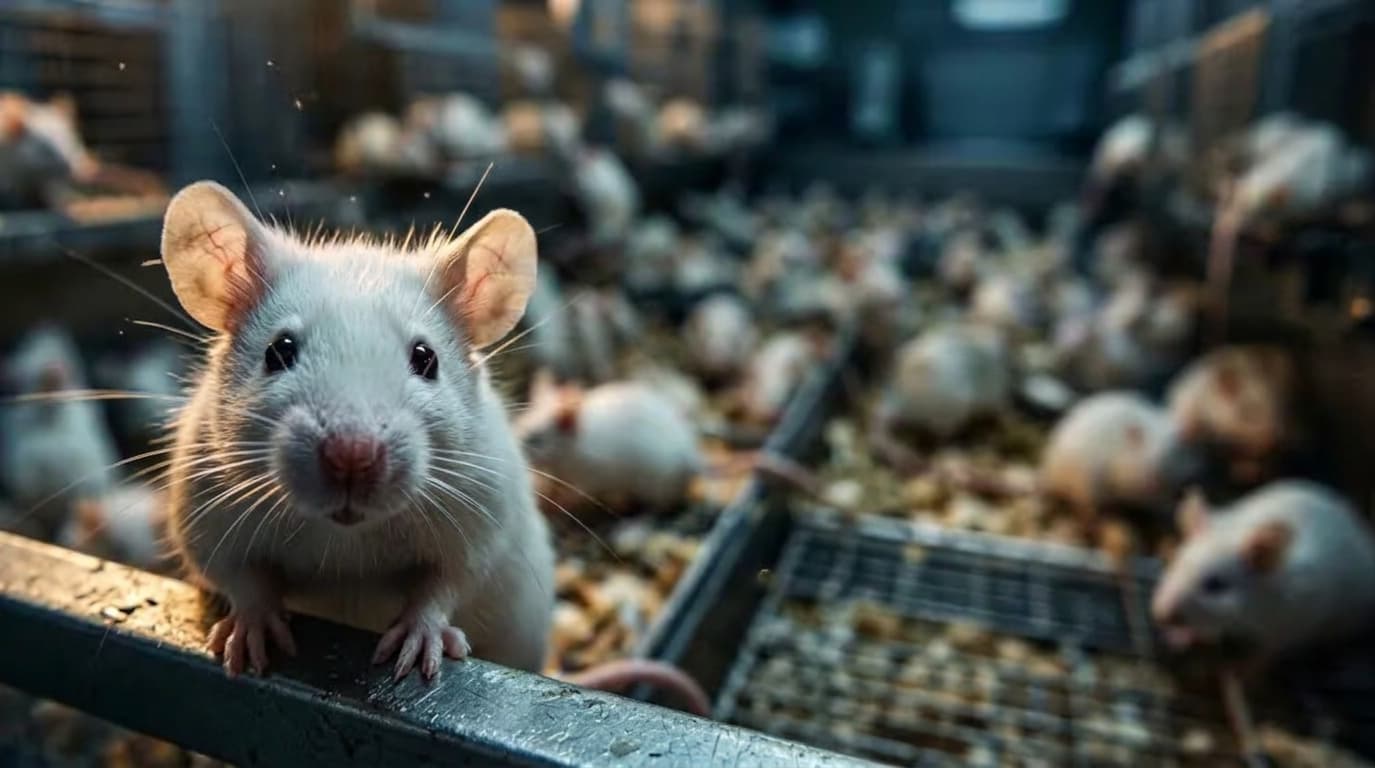
Imagine a place where you have everything: food never runs out, water is always nearby, the temperature is ideal, there are no predators, and not even disease threatens anyone. Exactly this kind of paradise was built for mice by the biologist John Calhoun in July 1968.
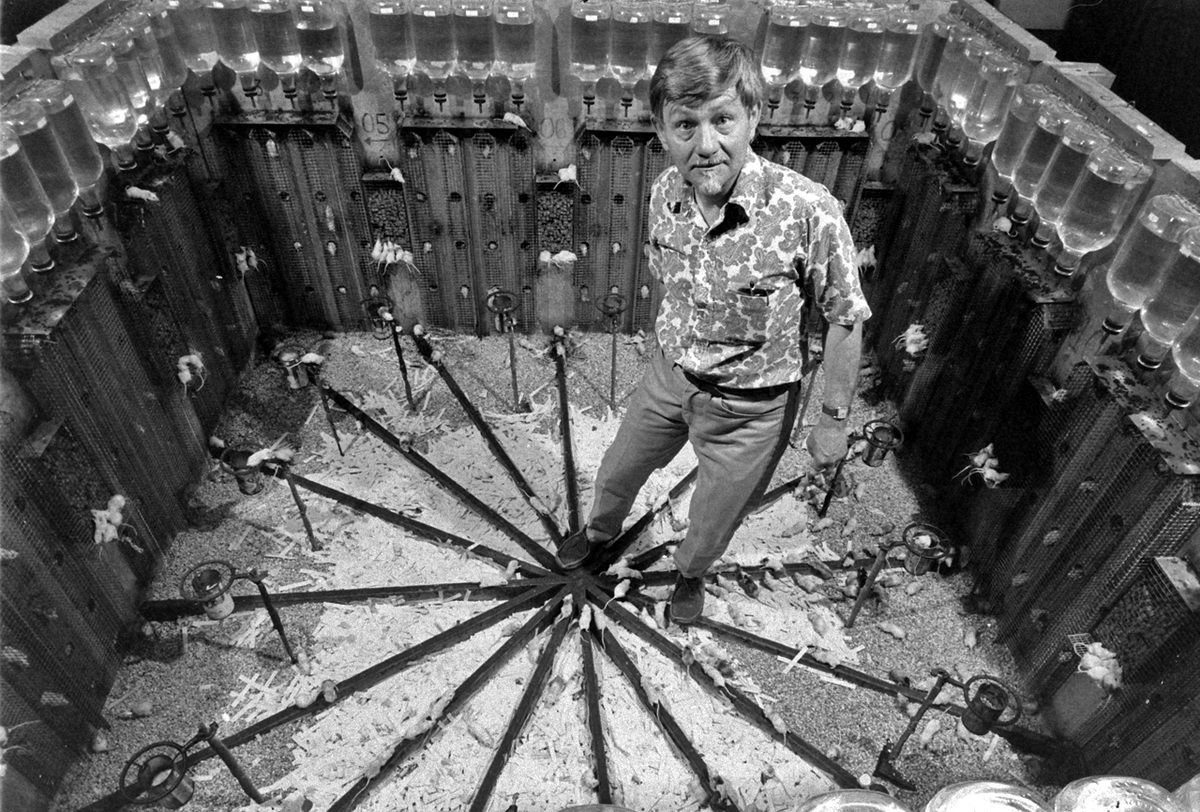
Officially the colony was called the "Mortality-Inhibiting Environment for Mice," and unofficially, "mouse paradise." The experiment also had a number, 25, which is why today it is called Universe 25. In this cube-shaped space (roughly 1.4 by 1.4 meters), Calhoun released eight white mice: four females and four males. The experiment took place at the US National Institute of Mental Health.
The First Months: Everything Goes Very Well
At first the mice needed a little time to get used to their new world. But then things went better than anyone could have imagined. The first pups were born after three and a half months, and the colony grew quickly: the population doubled every 55 days.
In paradise, pups almost never died.
In nature, predators, diseases and cold would wipe out a large share of the pups; here, nobody died. Around day 560 the population peaked at about 2,200 mice. The nests, meanwhile, were designed for about 3,800 mice, so there was still room. But this is exactly where something strange began.
When Paradise Ran Out of Room
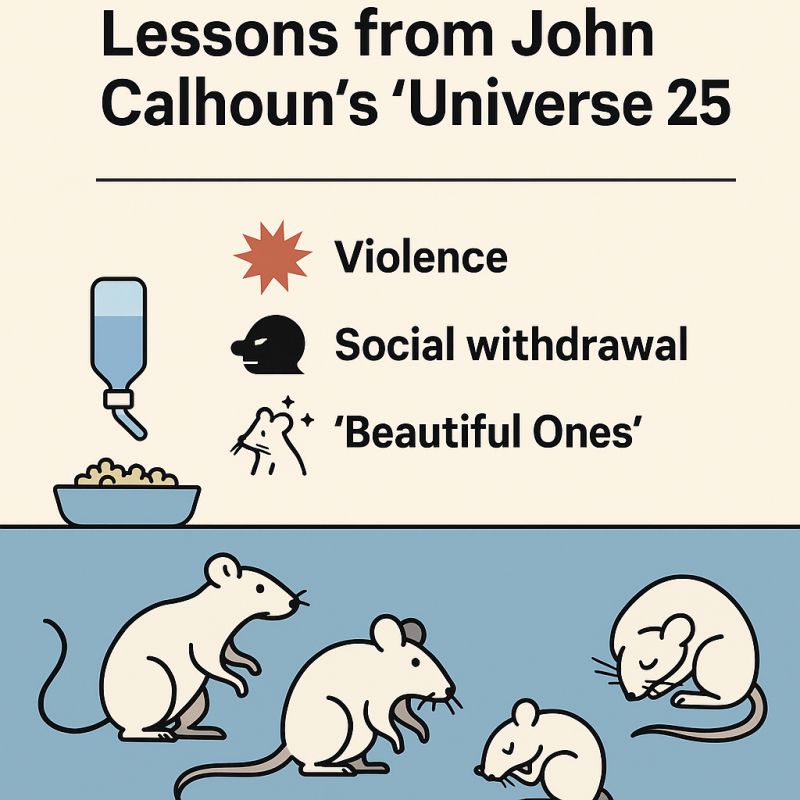
Physically they did not run out of space, but the social places were filled. Mice have rules: the strong take territory, while the weak usually leave for elsewhere and look for a new place. Here there was nowhere to go. The defeated stayed right where they were, while some of the strong males guarded several nests at once and would not let others in.
The whole system fell apart. Females, who should have cared for their pups, forgot their job: they dropped them, abandoned them, or carried part of the litter elsewhere and forgot the rest. Some females shut themselves away and lived like hermits in empty nests. Some males turned excessively aggressive, while others, on the contrary, avoided fighting.
Pup deaths rose sharply. Paradise, which was supposed to hold back mortality, could no longer sustain new life.
"The Beautiful Ones"
The strangest heroes of this story were named by Calhoun himself: "the beautiful ones." These males did not fight, did not seek out females and did not defend a nest. Their only occupation was self-care: for hours they scratched themselves and cleaned their fur. Outwardly they were flawless: smooth, glossy fur, no scars. But they had no interest in reproduction or in society. In a word: beautiful, solitary and completely free.
Paradise was missing something inside, and these "beautiful" males remained its symbol.

The End
After about 600 days, births stopped altogether. The older mice lived on a little longer, like hermits or endlessly grooming themselves, and in the end they died out. By 1972-1973 there was not a single mouse left in the colony. That is how paradise, where everything existed, disappeared.
The experiment was later repeated several times, but the result always turned out the same.
Calhoun clearly saw humans in this story too. He wrote that he was speaking about mice but thinking about people. In 1968, exactly when the experiment began, the book "The Population Bomb" came out, spreading fear of overpopulation. Universe 25 quickly became a symbol of this fear.
 Today the experiment is read in different ways. For some it is a warning about overcrowded cities, for others a metaphor for low birth rates, and for still others an expression of excessive prosperity that takes challenge away from people.
Some offer a completely different explanation: the problem was not in numbers but in distribution. Aggressive males "occupied" many nests, and the rest of the space remained overcrowded.
Nothing in nature exists without a function. A predator regulates the number of prey, winter tests the strength of life, and hunger makes one grow and become stronger. We often perceive all this as bad, but in reality they are the regulators of the system.
When there is no more need for struggle, searching and defense, purpose disappears. When everyone has everything, place disappears too: who you are, what you do and for whom.
Nature does not create comfort; it creates balance, and these two are not the same. Balance is dynamic: it always pushes us to move, to search and to compete. Perhaps this is exactly why Calhoun's paradise, with its perfect conditions, remained a place where nature did not carry life on.
Oh, and finally: Universe 25 is an entertaining and thought-provoking story, but it is only a metaphor and not a sufficient basis for transferring conclusions directly to humans.
Sources
• Mouse Heaven or Mouse Hell?, Distillations
• This Old Experiment With Mice Led to Bleak Predictions for Humanity's Future, Smithsonian Magazine
• Behavioral sink, Wikipedia
• Universe 25 Experiment, The Scientist
• Mouse Utopia, Gwern